Long before “hacker” meant someone who breaks into systems, it meant someone who understood a system so well that they could make it do something new and elegant. In 1984 the journalist Steven Levy wrote that culture down in Hackers: Heroes of the Computer Revolution, and the most quoted part of the book is a short list of unwritten rules he called the hacker ethic.
Forty years later those rules are still everywhere, even where nobody names them: in open source, in code review culture, in the way we judge a colleague by their pull requests rather than their title. They also clash, sometimes hard, with the world many of us now work in: security, privacy, and safety-critical software where you cannot just open the box and try something.
This post walks through where the hacker ethic came from, what its six principles say in plain words, and which of them have aged well. Because this blog is mostly about automotive and safety-related software, I also look at what the ethic means in a field governed by standards like ISO 26262 and MISRA C.
Where it came from
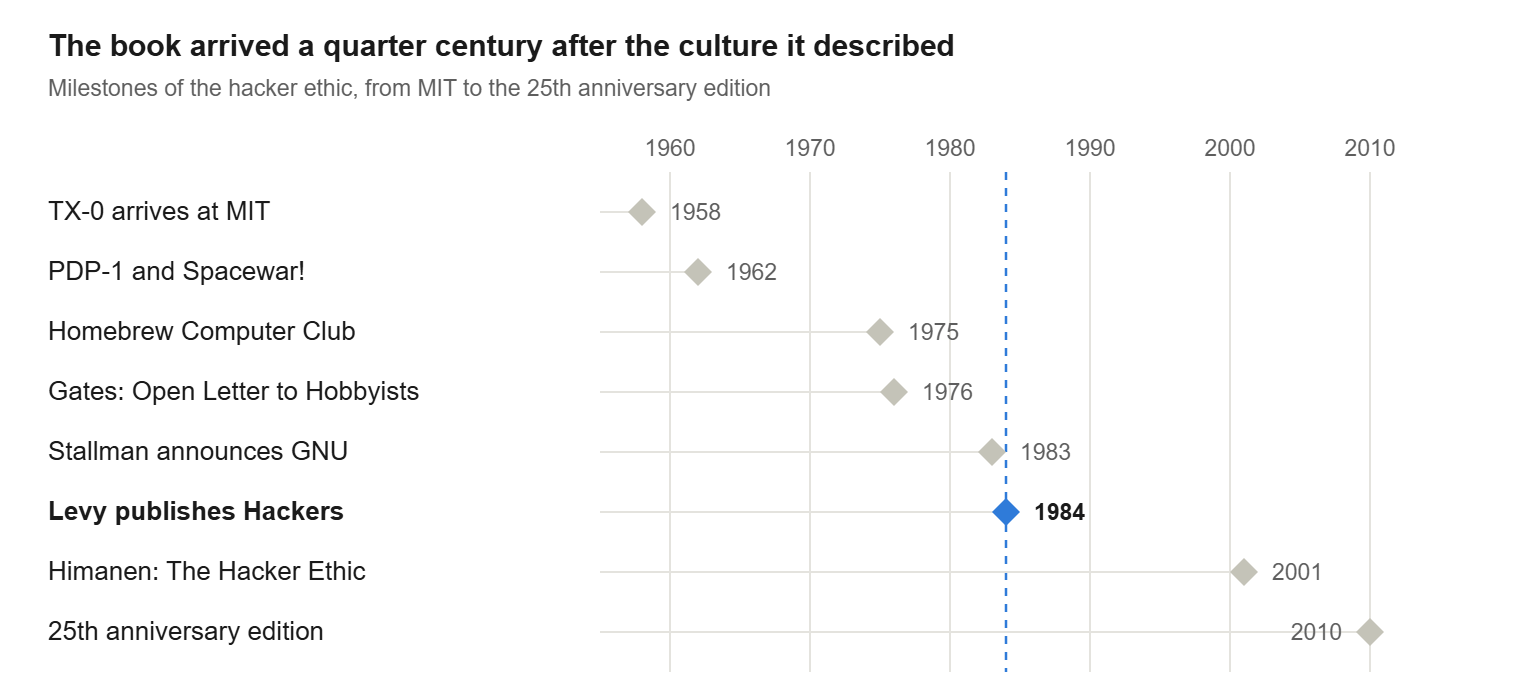
The story starts at MIT in the late 1950s with the Tech Model Railroad Club. Its members had built an elaborate relay-based control system for their layout, and “hack” was their word for a clever, playful piece of work done for its own sake. When the TX-0, an experimental transistor computer, arrived on campus around 1958, some of them discovered that a computer was the ultimate thing to hack. They signed up for the night shifts nobody wanted, and later moved on to DEC’s PDP-1, where Spacewar!, one of the first video games, was written in the early 1960s.



Levy did not invent the rules. Nobody wrote them down at the time; they were simply how this small community behaved. Levy’s contribution was to observe the behaviour, name it and turn it into a list. The same attitudes then travelled west to the Homebrew Computer Club in the 1970s and, through Richard Stallman and the free software movement, into the open source world we work in today.
It was never frictionless. When Bill Gates found that hobbyists were freely copying his BASIC for the Altair, he wrote his 1976 “Open Letter to Hobbyists” asking them to pay. That letter is a neat summary of the tension the ethic has carried ever since: sharing versus earning a living from software.
The six principles in plain words
Levy’s list is short. Paraphrased, it says:
- Access to computers, and to anything that teaches you how the world works, should be unlimited. Levy calls this the Hands-On Imperative: the best way to understand a system is to take it apart, try things and see what happens.
- Information should be free. Not free as in price, but free to flow. A program that fixes a problem should be passed on so that others can improve it instead of reinventing it.
- Mistrust authority and promote decentralisation. Bureaucracies, whether in a company, a government or a university, slow the flow of information, so open and decentralised systems are better.
- Judge hackers by their hacking. Not by degrees, age, position or background. The work speaks for itself.
- You can create art and beauty on a computer. A short, elegant routine that does more with fewer instructions was admired the way a good proof is admired.
- Computers can change your life for the better. And, by extension, spreading the ethic would make the world better too.


Read today, the list sounds almost obvious, and Levy himself made that point in the 25th anniversary edition. That is the best evidence of its influence: we absorbed it so completely that it no longer looks like a position anyone had to argue for.
Three generations, one ethic
The book follows the ethic through three groups, each in a different place and with a different relationship to money:
| Generation | Where and when | What they hacked | Relationship to money |
|---|---|---|---|
| True hackers | MIT, late 1950s and 1960s | Mainframes and minicomputers: the TX-0, the PDP-1, later the AI Lab’s time-sharing systems | Mostly indifferent; the machine time was the reward |
| Hardware hackers | Bay Area, 1970s: Homebrew Computer Club, People’s Computer Company | Kits and the first personal computers, such as the Altair 8800 and the Apple I | Hobby turning into business; companies were founded at club meetings |
| Game hackers | Early 1980s home computer software houses | Games for the Apple II and other home computers | Commercial from the start; royalties and publishers |




The direction of travel is the interesting part. Each generation kept the curiosity and the pride in elegant work, but drifted further from the idea that software should simply be shared. Levy ends the original book with Richard Stallman, whom he described as the last of the true hackers. In hindsight that was the wrong ending: Stallman’s free software movement, and later open source, carried the ethic further than anyone in 1984 expected.
What aged well, and what did not
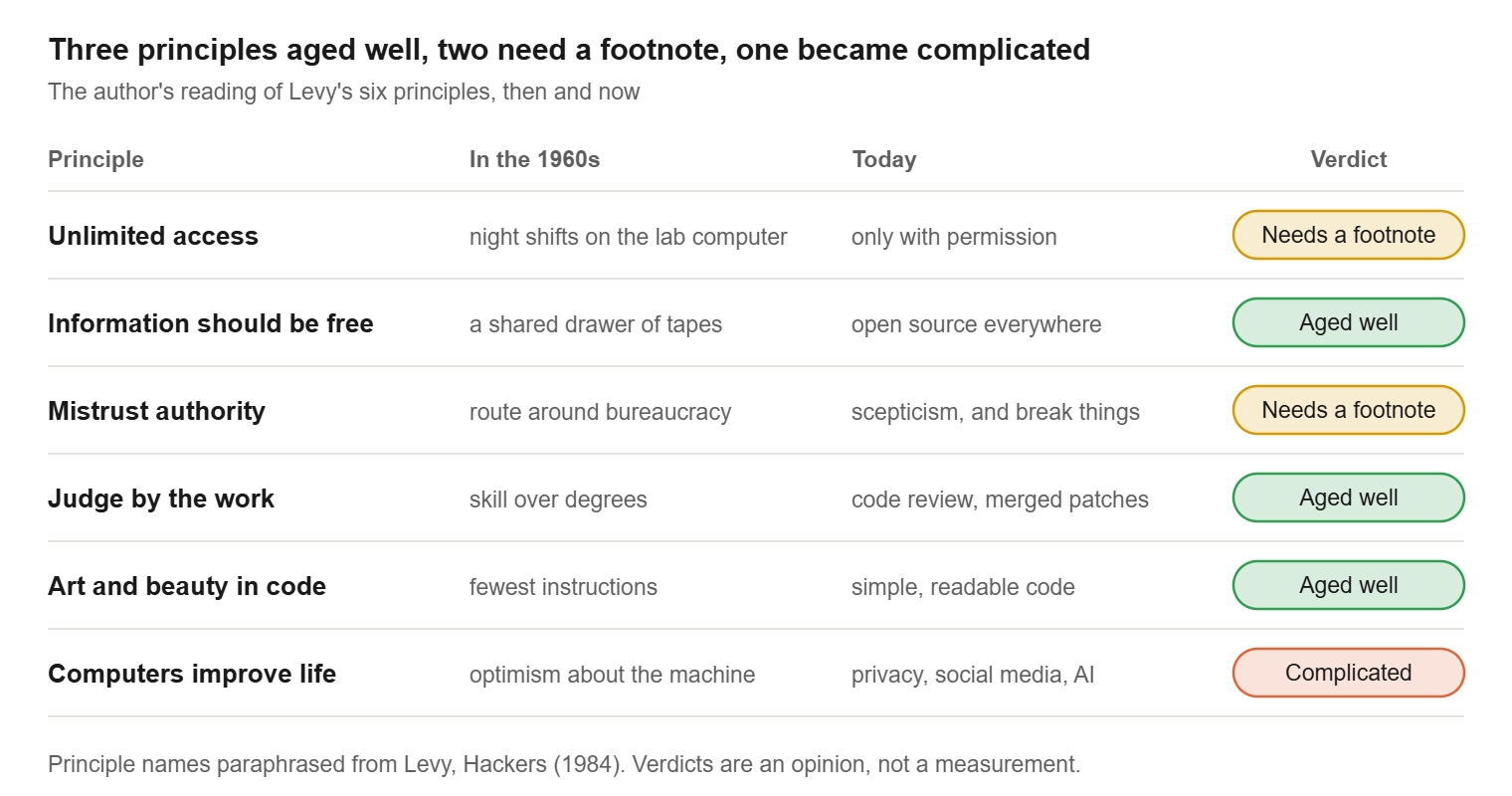
Forty years is long enough to test each principle against reality. My honest scorecard:
Aged well. Information should be free won in a way 1984 could not imagine. Most of the software stack you use today, from the Linux kernel to compilers and the libraries in your build, is open source. Judge people by their work lives on in code review and in open source projects where a good patch matters more than a CV. Beauty in code survives as our obsession with readable, simple code, even if we no longer count instructions.
Needs a footnote. Unlimited access sounded harmless when the system was a university computer used by twenty people. Applied to systems that hold other people’s data, it becomes unauthorised access. The modern answer is responsible disclosure and bug bounty programmes: keep the curiosity, but ask permission and report what you find. Mistrust authority produced healthy scepticism, but also a “move fast and break things” culture that broke more than a few things.
Turned out more complicated. Computers make life better is true for many people, and also the source of most of today’s arguments about social media, surveillance and AI. The early hackers rarely asked who would be affected by their work beyond the people in the room. Critics have also pointed out that the culture Levy described was almost entirely young and male, and that “judged by your hacking” worked best for people who already had access to a computer at 3 a.m.
The picture below summarises where each principle stands today, in my view.
The hacker ethic in a regulated world
At first sight, automotive software is the opposite of everything Levy describes. You do not get unlimited access: you work through change requests, baselines and reviews. Information is not free: a lot of it sits behind NDAs and supplier contracts. Authority is built into the process, and a clever trick in the code is more likely to be flagged by a MISRA checker than admired.
But I think the ethic survives in these teams, translated rather than abandoned:
- The Hands-On Imperative becomes the test bench. You cannot experiment on a car on the motorway, so you build a place where experimenting is safe: simulation, software-in-the-loop, hardware-in-the-loop, a test track. The best safety engineers I know are deeply curious people who simply moved their curiosity somewhere it cannot hurt anyone.
- Free information becomes traceability and open tooling. Inside a project, the requirement, design, code and test should be visible to everyone who needs them. Outside it, much of the industry now runs on open source, from Linux and AUTOSAR Adaptive implementations to compilers and test frameworks.
- Mistrust of authority becomes independent review. ISO 26262 asks for confirmation measures carried out by people who did not do the work. That is institutionalised scepticism: nobody’s word is enough, only evidence.
- Judge by the work becomes evidence-based safety. A safety case does not care about your title; it cares about whether your argument and your test results hold up.
- Beauty in code becomes simplicity. Elegant in 1962 meant fewest instructions. Elegant in safety-critical code means the simplest design a reviewer can fully understand, with one entry and one exit and no hidden control flow. Different aesthetics, same respect for craft.
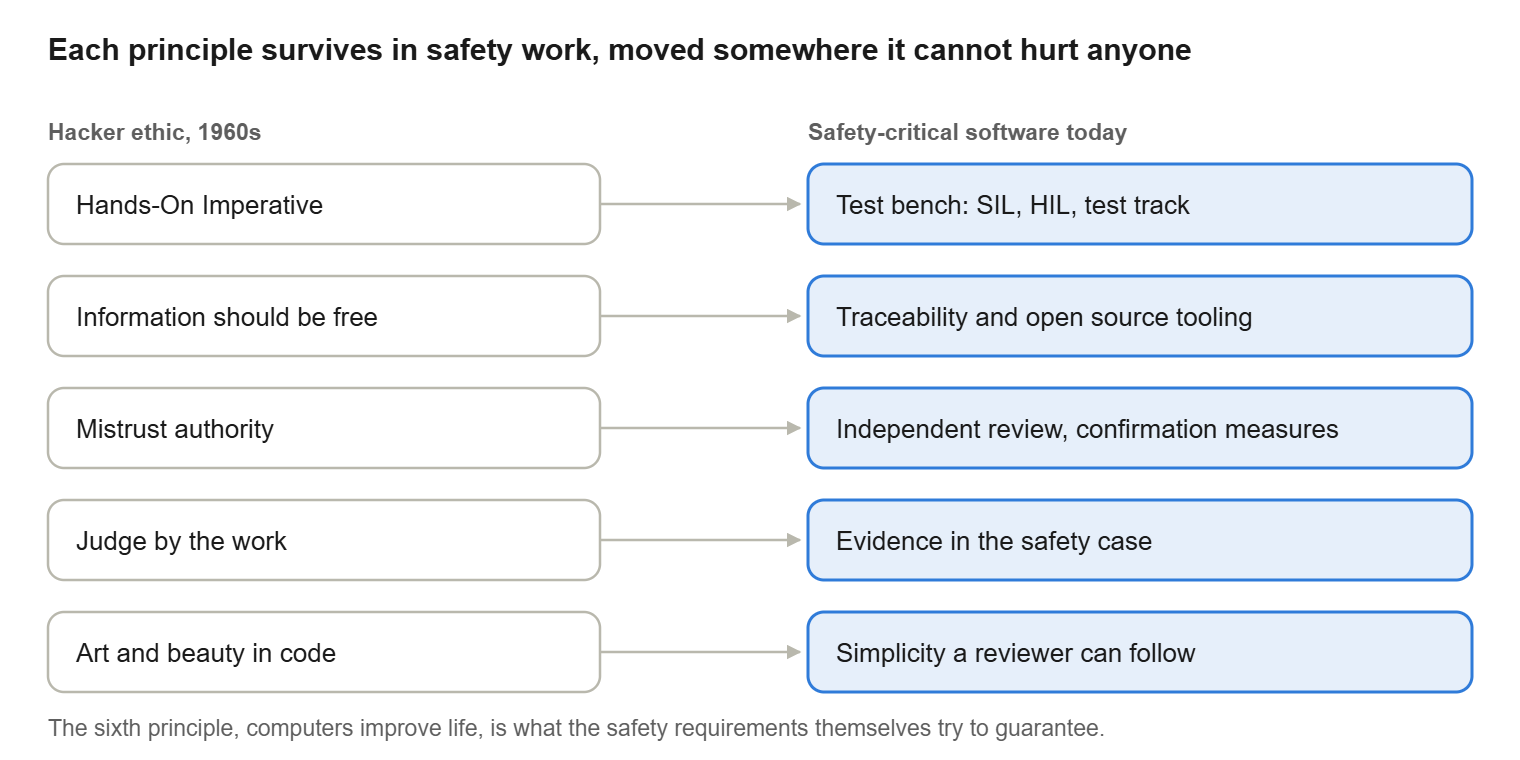
The principle that needs the most care is the sixth. “Computers make life better” is exactly what we are trying to guarantee when we write safety requirements. The regulated world simply adds the question the early hackers seldom asked: better for whom, and what happens when it fails?
What I take away
- Keep the curiosity, change the venue. The urge to take a system apart is the most valuable trait an engineer has. In safety-related work it belongs on the bench, not in production.
- Share what you can. Write things down, publish tools, answer the question in the team channel. Free information still makes systems better, even inside a company.
- Let the work speak. Code review, test results and clear documentation are the fairest way to judge anyone, including yourself.
- Elegance means simplicity now. The most beautiful code is the code a tired reviewer can understand at the end of the day.
- Ask the question the original hackers skipped. Who is affected by what I build, and what happens when it fails?
Sources
- Steven Levy, Hackers: Heroes of the Computer Revolution, Anchor Press/Doubleday, 1984; 25th anniversary edition, O’Reilly, 2010
- Project Gutenberg, Hackers, Chapters 1 and 2
- Wikipedia, Hacker ethic
- Wikipedia, Hackers: Heroes of the Computer Revolution
- Communications of the ACM, When Hackers Were Heroes
- Pekka Himanen, The Hacker Ethic and the Spirit of the Information Age, 2001
- ISO 26262 in Plain English and MISRA C:2012 Without the Pain
Cover photo by Yuheng Ouyang on Unsplash. Other photos from Wikimedia Commons under the licences named in their captions.