Most software engineers meet ISO 26262 in the same way: a requirement arrives tagged “ASIL B”, a safety manager asks for evidence nobody planned for, and someone mentions that the standard has twelve parts and about a thousand pages. It is easy to conclude that functional safety is a separate world run by specialists.
It is not. For a developer, ISO 26262 boils down to a small set of ideas: how risk is classified, how a hazard becomes a requirement you can implement, what extra rigour your ASIL asks of design, code and tests, and how safety-relevant code is protected from everything else. This post explains those ideas in plain English, with pictures, and points to where they sit in the standard.
It builds on two earlier posts: What Is Automotive SPICE? covers the process side, and From SWE.1 to SWE.6 follows one requirement through the V-model. ISO 26262 adds the safety layer on top of both. This is an orientation, not a substitute for the standard or for your project’s safety plan.
What ISO 26262 is, and what it is not
ISO 26262 is the functional safety standard for electrical and electronic systems in series-production road vehicles. Its question is narrow and precise: what happens when the system malfunctions, and how do we keep the resulting risk acceptably low? The current edition is ISO 26262:2018; a third edition is in preparation and is not expected before 2027.
Three things it is not:
- Not a security standard. An attacker who makes the brakes misbehave is ISO/SAE 21434’s territory, although the two have to talk to each other.
- Not about a system doing the wrong thing while working as designed. A camera that is fine but cannot see a white truck against a bright sky is a performance limitation; that belongs to ISO 21448, SOTIF.
- Not a process maturity model. Automotive SPICE asks how well you develop; ISO 26262 asks whether the product is safe enough and whether you can show it.
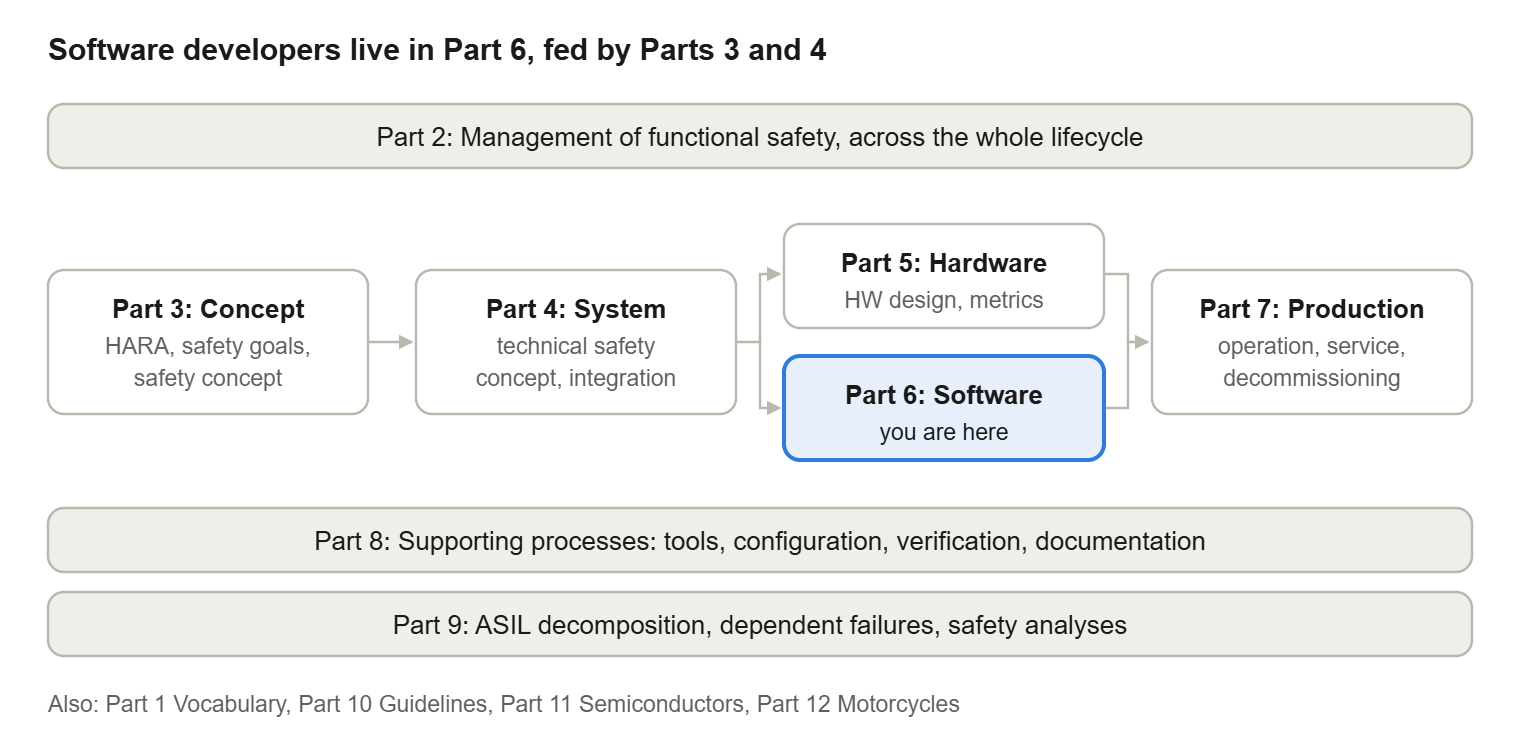
The standard has twelve parts. As a software developer you will live mostly in Part 6, use Part 8 (tools, configuration, verification) and Part 9 (ASIL decomposition, dependent failures) now and then, and receive inputs from Parts 3 and 4. The picture below shows where your work sits.
ASIL in plain English
An ASIL, Automotive Safety Integrity Level, is a label that says how much rigour a safety requirement deserves. There are four levels, A (least demanding) to D (most demanding), plus QM, “quality managed”, which means normal good engineering is enough. The ASIL is not chosen by the developer. It comes out of the hazard analysis and risk assessment (HARA) in the concept phase, from three questions asked about each hazardous event:
- Severity (S0 to S3): if it happens, how badly can people be hurt? S1 is light to moderate injuries, S3 is life-threatening or fatal.
- Exposure (E0 to E4): how often is the vehicle in the situation where the hazard matters? E1 is very rare, E4 is most drives.
- Controllability (C0 to C3): can a typical driver or other road user avoid the harm? C1 is simply controllable, C3 is difficult or impossible to control.
The standard combines the three in a table. A handy way to remember it: number the classes, add S + E + C, and a total of 10 gives ASIL D, 9 gives C, 8 gives B, 7 gives A, and anything lower is QM. Any class 0 also means QM. Loss of braking on all wheels while driving is the classic ASIL D; a tail light failure is a typical ASIL A or QM.
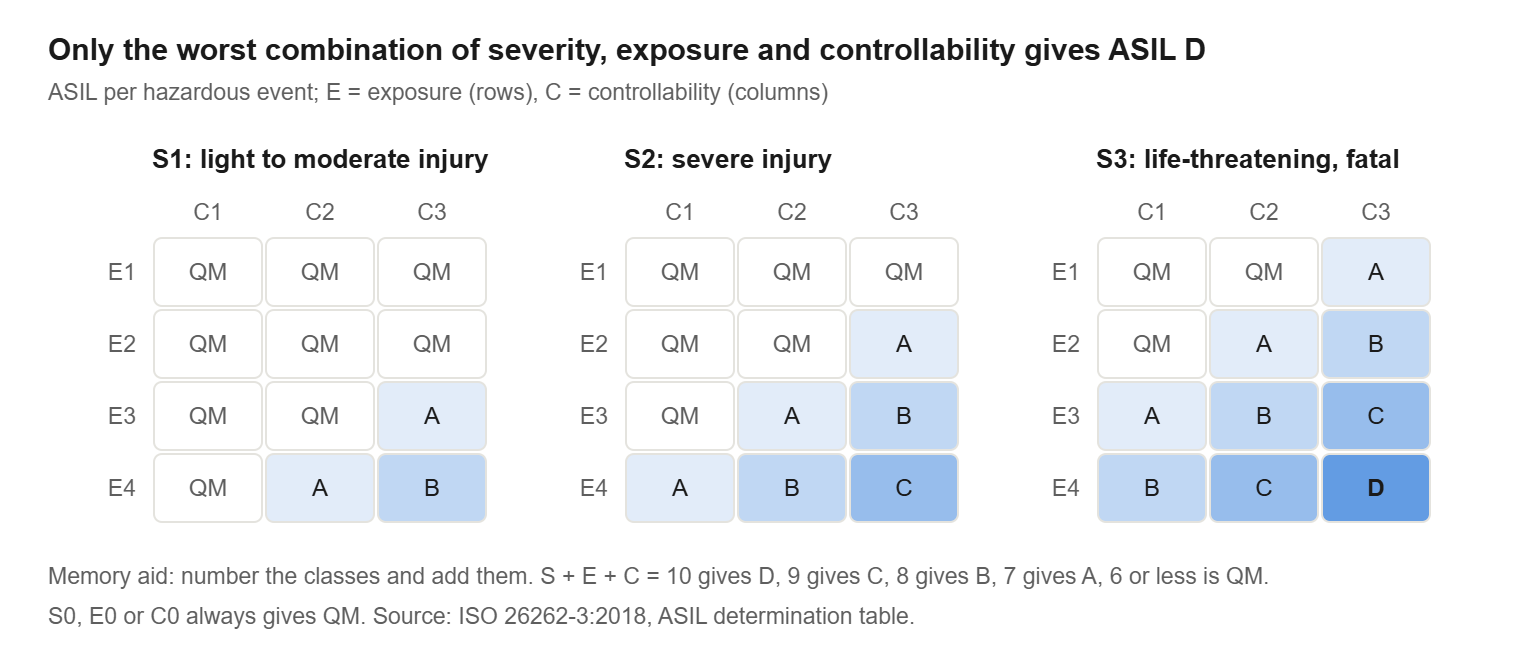
Two consequences matter for developers. First, the ASIL belongs to the safety goal and the requirements derived from it, not to the whole ECU or to you. Second, the ASIL is inherited down the chain: a software safety requirement derived from an ASIL C safety goal is ASIL C, unless an explicit ASIL decomposition says otherwise.
From hazard to a line of code
The most useful thing a developer can understand about ISO 26262 is the chain that connects a hazard on the road to a requirement in your backlog. Take electric power steering, a textbook example. The numbers below are illustrative.
- Hazard (Part 3, HARA): the steering system applies torque the driver did not ask for, at motorway speed. Severity S3, exposure E4, controllability C3: ASIL D.
- Safety goal (Part 3): “Avoid unintended steering torque above a tolerable limit.” A safety goal is a top-level safety requirement. It says what must not happen, not how.
- Functional safety requirement (Part 3, functional safety concept): “Detect an implausible assist torque and switch the assist off within the fault-tolerant time interval.” Now we have a safety mechanism, a safe state (no assist, the driver steers manually) and a time limit.
- Technical safety requirement (Part 4, technical safety concept): the requirement is allocated to elements of the architecture: the torque sensor, the microcontroller, the motor driver, and software.
- Software safety requirement (Part 6): “TorqueMonitor shall command zero assist torque within 10 ms when the commanded and the plausible torque differ by more than 3 Nm for 5 consecutive 1 ms cycles.”
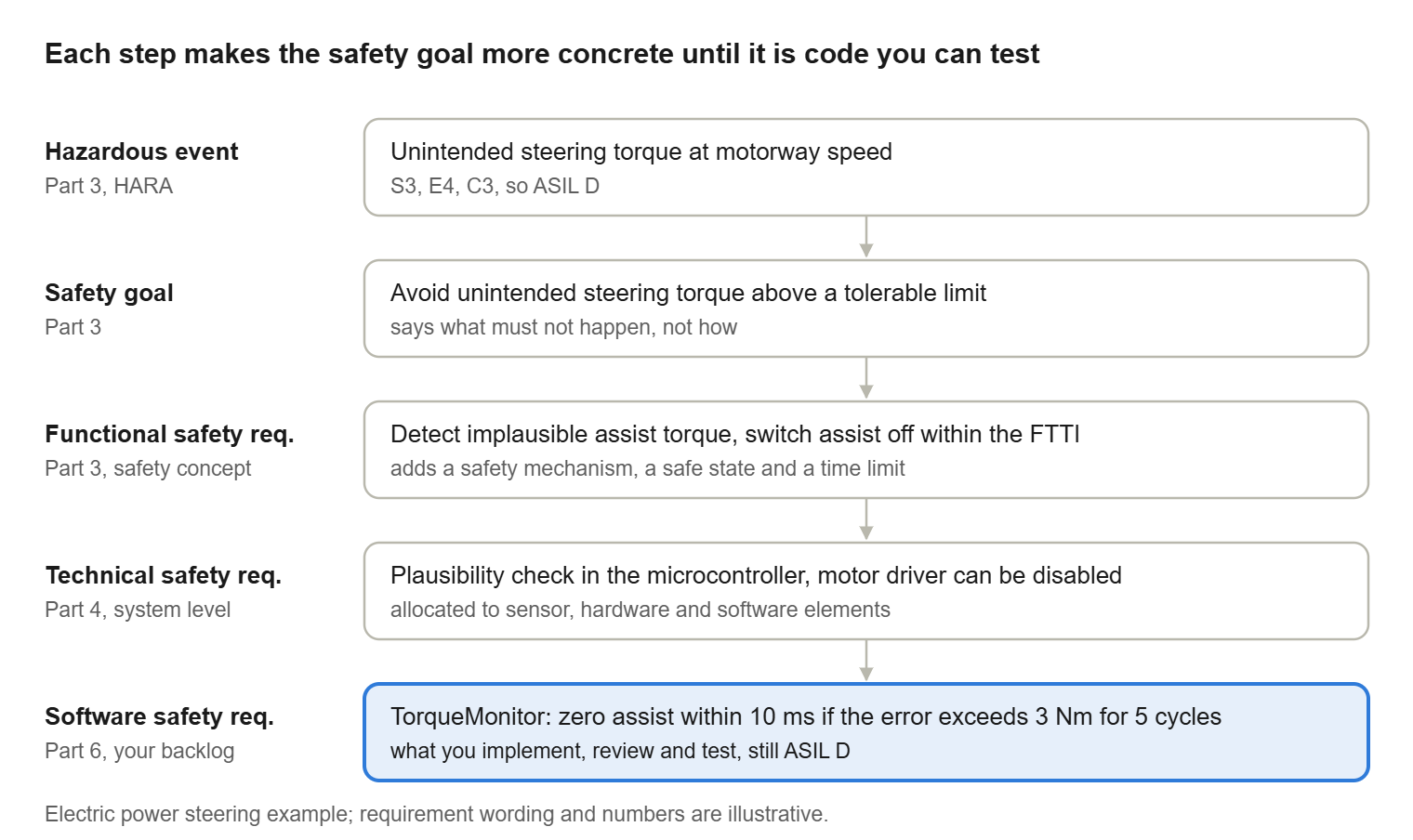
Only the last step is written for you, but you need to know the other four. They explain why the 10 ms exists, what “safe” means for this item, and which safety goal you are protecting when you argue about a corner case. Two terms come up constantly: the fault-tolerant time interval (FTTI), how long a fault can be present before harm can occur, and the safe state, the operating mode the system falls back to. Your timing requirements are slices of the FTTI, exactly like the timing budget in the SWE.1 to SWE.6 post.
What Part 6 actually asks of you
Part 6, product development at the software level, follows the same V you already know: software safety requirements, architectural design, unit design and implementation, unit verification, integration and verification, and testing of the embedded software. What it adds is a set of tables. Each table lists methods, and each method is marked per ASIL as ++ (highly recommended), + (recommended) or o (no recommendation). The higher the ASIL, the more of the ++ methods you are expected to apply, and if you skip one you must give a rationale.
In practice the tables translate into a short list of habits:
| Area | What it means day to day |
|---|---|
| Modelling and coding guidelines | Use a language subset (for C, typically MISRA C), strong typing, defensive implementation and limits on complexity. |
| Architectural design | Hierarchical structure, restricted size and coupling of components, scheduling you can analyse, and limited use of interrupts. |
| Unit design | One entry and one exit per function, no dynamic memory or recursion, initialised variables, no hidden data or control flow. |
| Safety analysis of the software architecture | Ask “what if this component fails or gets bad input?” and add safety mechanisms where the answer is a violated safety requirement. |
| Unit verification | Requirements-based tests, interface tests, fault injection, static analysis, review or inspection, and structural coverage. |
| Test case derivation | Requirements analysis, equivalence classes, boundary values and error guessing. |
| Embedded software testing | Tests in a representative environment: hardware-in-the-loop, the target ECU, or the vehicle. |
None of this is exotic. It is good engineering written down, with the rigour dialled up by ASIL. The difference is that for safety-related software you must be able to show that you did it, for this release, with this compiler and these tools. The MISRA C post covers the coding guideline part in detail.
Mixed criticality: freedom from interference and ASIL decomposition
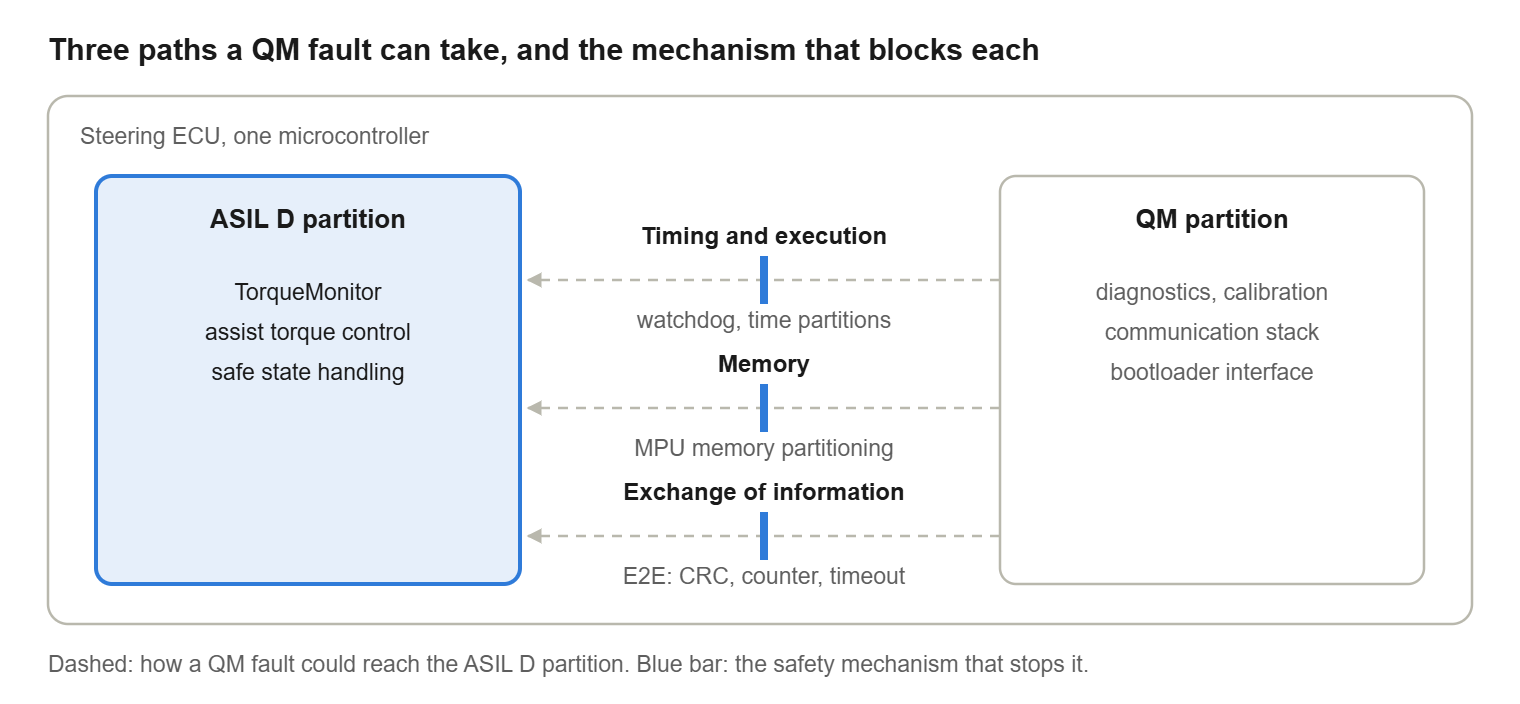
Real ECUs mix safety-related and ordinary software. The steering ECU also runs diagnostics, calibration, a bootloader and perhaps a third-party communication stack. ISO 26262 gives you two options. Either everything on the ECU is developed to the highest ASIL present, which is expensive, or you show freedom from interference: a fault in the lower-ASIL or QM software cannot cause a violation of a safety requirement in the higher-ASIL software.
Part 6 names three kinds of interference to argue about:
- Timing and execution: a QM task that loops forever, blocks a resource or delays the safety task past its deadline. Typical answers: a watchdog, program flow monitoring, time partitioning in the operating system.
- Memory: a QM component that overwrites the safety component’s data. Typical answer: memory partitioning enforced by the MPU, with each partition in its own region.
- Exchange of information: corrupted, repeated, lost, delayed or masqueraded messages between components or ECUs. Typical answer: end-to-end protection with a CRC, a sequence counter and a timeout.
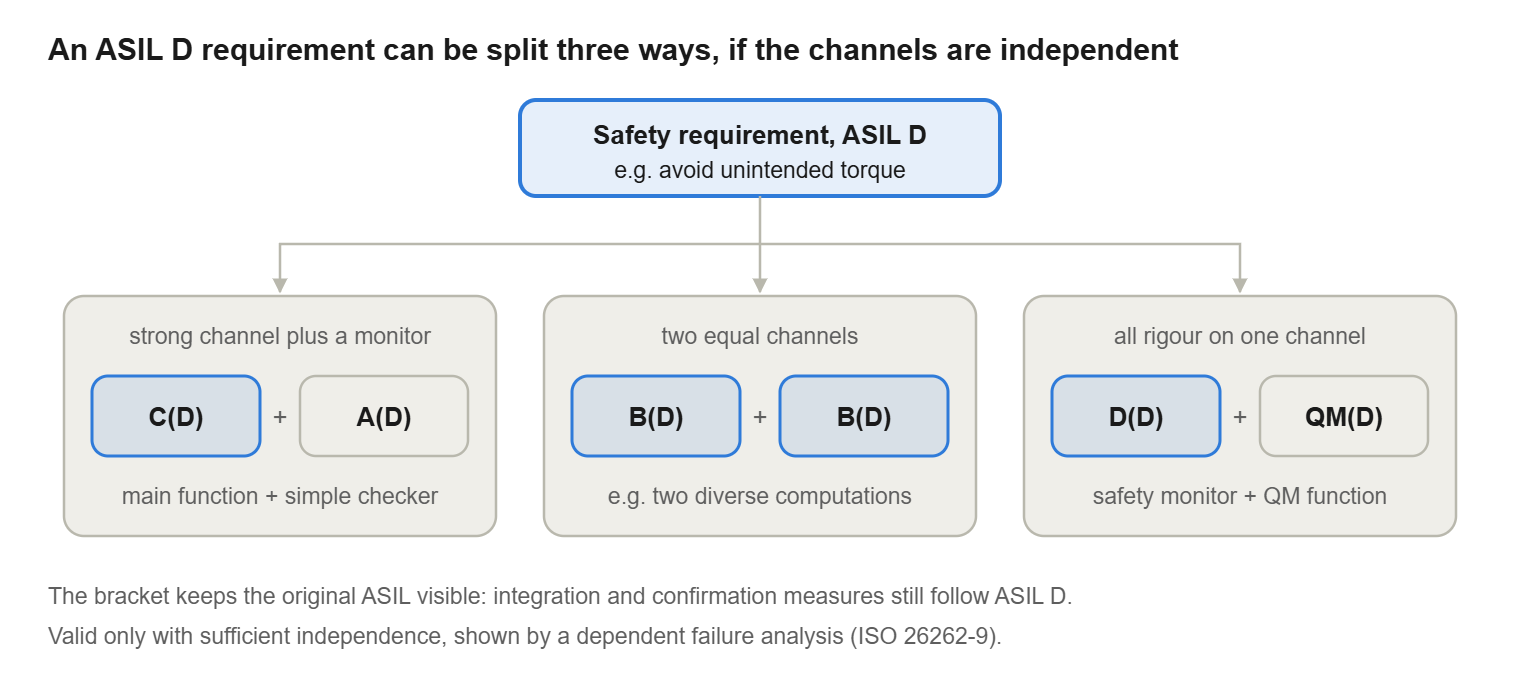
ASIL decomposition (Part 9) is the related trick at requirements level. A requirement can be split into two redundant requirements, implemented by sufficiently independent elements, each with a lower ASIL. ASIL D can become C(D) + A(D), B(D) + B(D) or D(D) + QM(D). The letter in brackets keeps the original ASIL visible, because the processes around those elements, such as confirmation measures and integration, still follow ASIL D. Decomposition is not a discount coupon: if both channels share a compiler bug, a power supply or the same badly specified input, they are not independent, and the argument collapses. That is what the dependent failure analysis in Part 9 is for.
How deep you must test, and why your tools matter
The clearest example of rigour scaling with ASIL is structural coverage at unit level. ISO 26262-6:2018 recommends statement coverage for all ASILs, but it is only highly recommended at A and B; from B upwards branch coverage is highly recommended, and at ASIL D MC/DC (modified condition/decision coverage) becomes highly recommended too. At software integration level, function and call coverage play the same role.
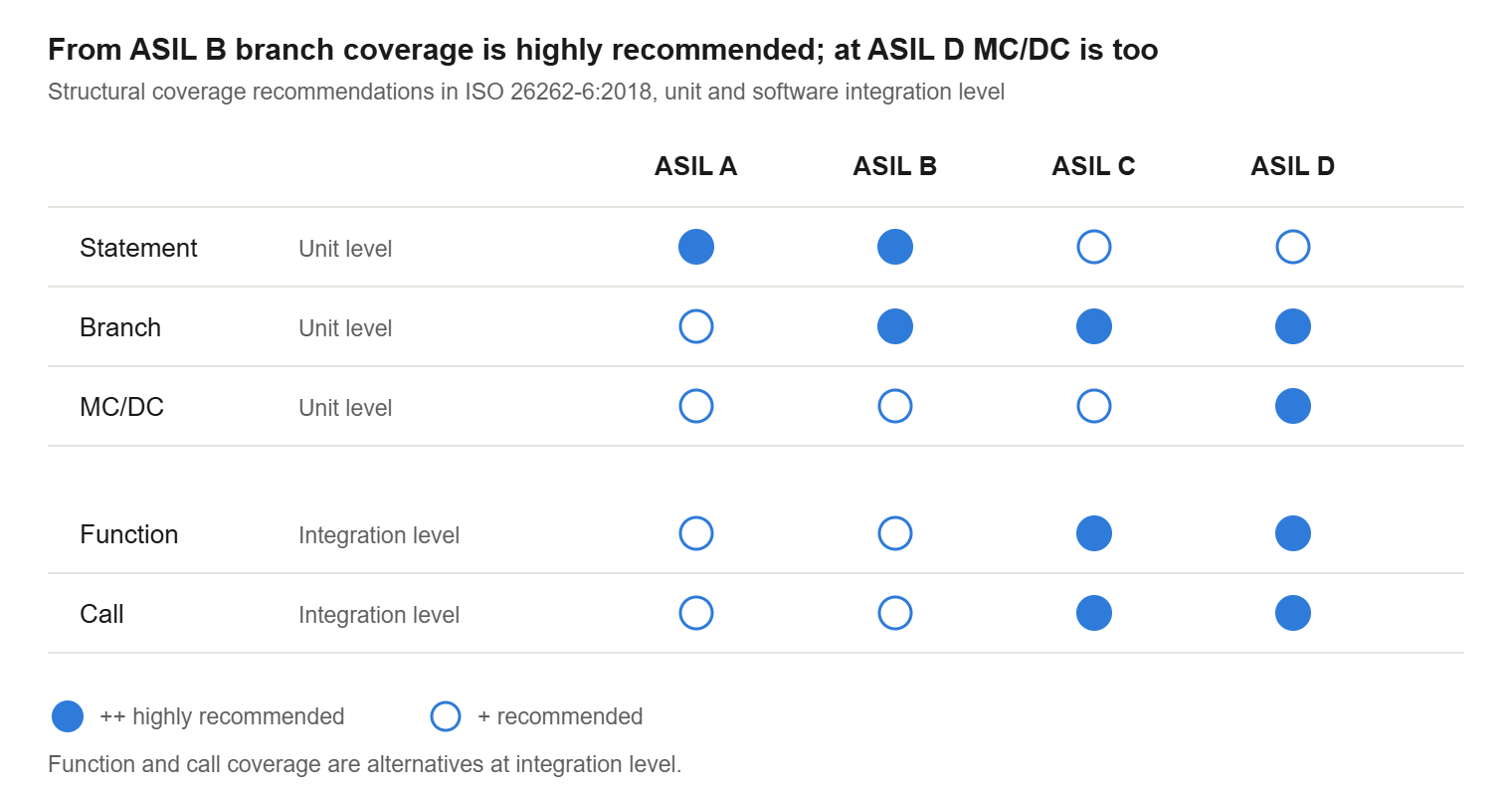
Two practical notes. Coverage is a measure of how complete your requirements-based tests are, not a goal in itself: writing tests just to hit uncovered lines defeats the purpose. And missing coverage needs a written rationale, for example defensive code that cannot be reached without fault injection.
The second thing developers often miss is Part 8, clause 11: confidence in the use of software tools. Every tool that could introduce or fail to detect an error in safety-related software needs a classification:
- Tool impact (TI): can a malfunction of the tool put an error into the product or let one go unnoticed? TI1 means no, TI2 means yes.
- Tool error detection (TD): how likely is it that such an error is caught anyway by other steps? TD1 high confidence, TD3 low.
- The two give a tool confidence level: TCL1 needs nothing more, TCL2 and TCL3 need qualification, for example increased confidence from use, evaluation of the tool’s development process, or validation of the tool.
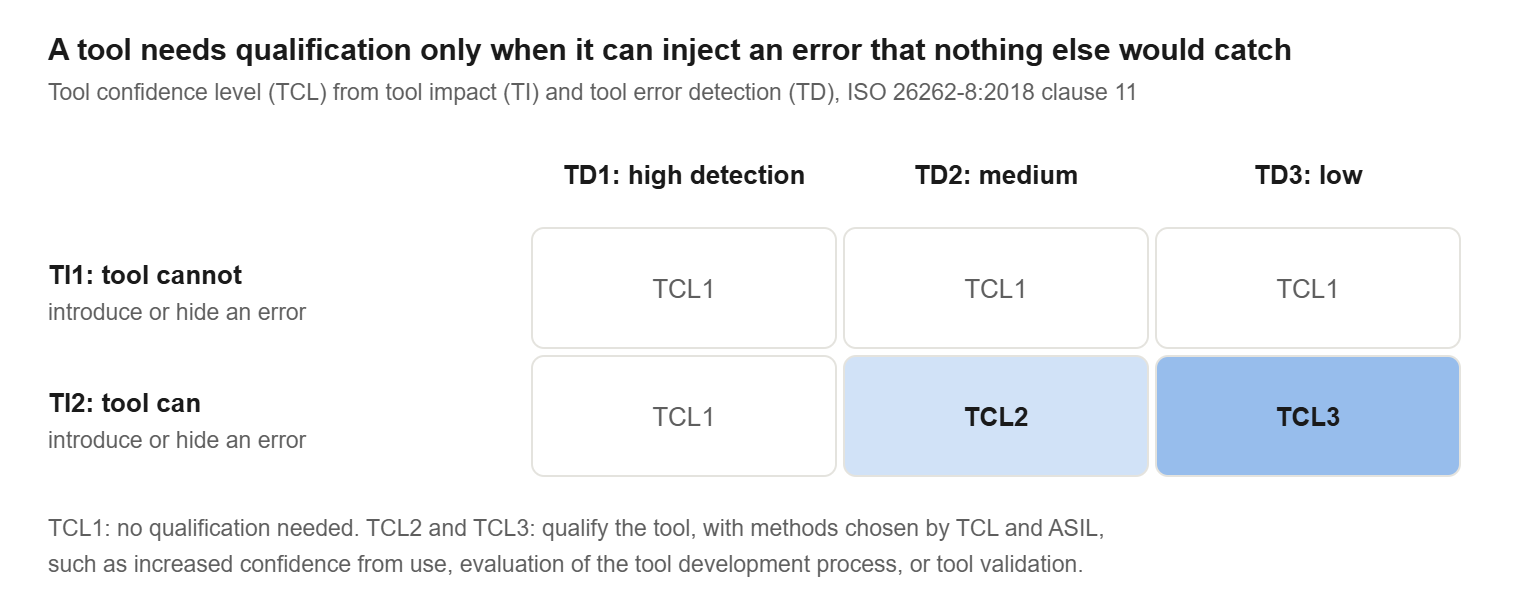
Compilers, code generators, static analysers and test frameworks are the usual suspects. A static analyser that silently stops checking a file is a TI2 tool; if nothing else would catch that, it needs qualification.
ISO 26262 and Automotive SPICE side by side
On most automotive projects you live under both at once, and they are easy to confuse because they share the V-model, traceability and verification. The difference is the question each one asks.
| Automotive SPICE | ISO 26262 | |
|---|---|---|
| Question it asks | Is the development process capable and well run? | Is the product free of unreasonable risk from malfunctions? |
| Scope | All software and system development, safety-related or not | Safety-related E/E systems and their elements |
| Scaled by | Capability level (0 to 5) | ASIL (QM, A to D) |
| Typical evidence | Work products, traceability, review records, assessment report | Safety case, safety analyses, verification results, confirmation measures |
| Outcome | Assessment rating per process | Functional safety assessment and a safety case argument |
The good news is that the work overlaps a lot. A clean SWE.1 to SWE.6 flow with traceability is most of what Part 6 needs. ISO 26262 then adds the safety-specific layer on top: ASIL-dependent methods, safety analyses of the architecture, freedom from interference, tool qualification and an independent functional safety assessment. Build one process that satisfies both, rather than two parallel sets of documents.
Common misconceptions
- “Our ECU is ASIL D.” Requirements and safety goals carry ASILs; an ECU hosts elements that implement them. Saying “the ECU is ASIL D” usually hides the question of which parts really need ASIL D rigour.
- “ASIL D software is bug-free.” It is software developed with methods that make certain classes of systematic faults much less likely, plus safety mechanisms for what remains. That is a much more honest claim.
- “The safety manager does the safety stuff.” The safety manager plans and coordinates. The evidence comes from requirements, designs, code, reviews and tests written by developers.
- “ISO 26262 certification.” There is no certification of a product to ISO 26262 in the way the phrase suggests. There are functional safety assessments, audits and confirmation reviews; tool vendors and component suppliers often present third-party certificates for their part.
- “QM means we do not care.” QM means the normal quality process is sufficient. It still needs the freedom from interference argument when QM code shares an ECU with safety-related code.
What I take away
- Start from the safety goal. Every software safety requirement should be traceable to one. If you cannot name the hazard you are protecting against, ask before you write code.
- The ASIL is a dial, not a different world. The same V, the same reviews and tests, with more of the highly recommended methods as the ASIL goes up.
- Most of the cost sits in mixed criticality. Decide early how freedom from interference will be shown, because retrofitting memory partitioning or end-to-end protection is painful.
- Treat tools as part of the product. A tool classification takes an afternoon; finding out during the assessment that your compiler needed qualification takes much longer.
- One process, two standards. Good Automotive SPICE practice is the foundation; ISO 26262 is the safety layer on top.
Sources
- ISO 26262-6:2018, Road vehicles, Functional safety, Part 6: Product development at the software level
- UL Solutions, What to expect with version 3 of ISO 26262
- Verifysoft, ISO 26262 structural coverage recommendations
- Wikipedia, Automotive Safety Integrity Level
- What Is Automotive SPICE? A Practical Guide for Software Engineers
- From SWE.1 to SWE.6: How a Requirement Becomes Tested Code
- MISRA C:2012 Without the Pain
The power steering example and its numbers are illustrative. Always work from the standard itself and your project’s safety plan. Cover photo by Pietro De Grandi on Unsplash.